
A botched VIP client visit does not just lose a deal. It signals to your guest that your organization cannot execute. Forbes research consistently shows that client experience directly influences purchasing decisions at the executive level, often more than product features or pricing. Planning VIP client transportation Bay Area logistics alone requires juggling SFO flight tracking, hotel proximity to Sand Hill Road, and dinner reservations that actually reflect the city’s character. This guide covers what separates a forgettable visit from one your guest talks about for months, with specific, practical steps for hosts working with Bay Area executives, tech leaders, and inbound decision-makers.
Table of Contents
- Quick Takeaways
- Why Bay Area VIP Visits Demand Different Planning
- Building the Itinerary Around Your Guest’s Schedule
- VIP Client Transportation Bay Area: The Non-Negotiable First Impression
- Executive Hosting San Francisco: Dining, Venues, and Experiences
- Comparing Ground Transportation Options for VIP Visitors
- Managing Multi-Day Visits Across the Bay Area
- Frequently Asked Questions
- References
Quick Takeaways
| Key Insight | Explanation |
|---|---|
| Book chauffeured pickup before anything else | Ground transportation is the first physical touchpoint. A chauffeur holding a name sign at SFO arrivals sets tone immediately. Rideshares do not. |
| Track inbound flights in real time | Bay Area airports, especially SFO, have frequent delays. Your car service should monitor the flight and adjust pickup time automatically so your guest is never waiting. |
| Match vehicle size to group composition | A solo CFO in a Cadillac Escalade signals respect. Squeezing a four-person delegation into a sedan signals you did not think ahead. |
| Keep the schedule breathing room | Bay Area traffic on 101 or 280 can add 45 minutes without warning. Build buffer time between meetings, not just between airport and hotel. |
| Choose experiences specific to the Bay Area | A Napa wine tour or a private dinner in the Ferry Building beats a generic steakhouse. Specificity shows effort and local knowledge. |
| Pre-brief your chauffeur on the client | A professional chauffeur who knows your guest is a senior partner, not a first-name-basis conversation type, adjusts behavior accordingly. Give the car service context. |
| Confirm all logistics 48 hours out | Hotel, transportation, dinner reservations, and internal meeting rooms should all be reconfirmed two days before arrival, not the morning of. |
Why Bay Area VIP Visits Demand Different Planning
The Bay Area is not a single city. It is a network of distinct business hubs, each with its own traffic patterns, cultural expectations, and logistical quirks. Your VIP client might land at SFO, hold meetings in San Francisco’s Financial District, visit a partner campus in Menlo Park, and end the day with dinner in Sausalito. That itinerary crosses four counties and can involve radically different transit realities depending on the time of day.
A common mistake is treating the Bay Area like Manhattan, where the assumption is that everything is walkable or a short cab ride. In practice, the geographic spread from San Jose to Marin County is roughly 60 miles, and peak traffic on Highway 101 or Interstate 280 routinely turns a 20-minute drive into 75 minutes. This is not an edge case. It is Tuesday.
What this means for hosts is that the planning margin you need is higher here than in most other U.S. metro areas. Underestimating transit time is the single most common reason VIP visit schedules collapse mid-day. A credible hosting plan acknowledges this reality up front and builds the schedule around it, not around an optimistic map estimate.


Building the Itinerary Around Your Guest’s Schedule
The instinct when hosting a VIP is to fill every hour with impressive activities. Resist this. Executive-level guests, especially those traveling from different time zones, need white space. A visit that looks impressive on paper but leaves your client exhausted by 4 PM does not serve the relationship.
Start with the non-negotiables
Identify the two or three meetings or experiences that genuinely require your guest’s presence. Everything else, including the optional plant tour or the group cocktail hour, is subordinate to those anchor events. Build the schedule outward from those fixed points, then place transportation and meals around them.
In practice, this means the itinerary should have no more than three substantive commitments per day for a single executive guest. For a delegation of four or five people, you may be able to run parallel tracks, but only if your ground transportation can support the split logistics.
Account for jet lag and time zone offset
If your guest is flying in from London, Tokyo, or New York, their cognitive peak hours will not align with yours for at least the first day. Scheduling a complex contract negotiation as the first thing after a red-eye flight is a decision you will regret. Place strategic conversations in the late morning of day two, when they have had one night’s sleep in the local time zone. Use day-one arrival logistics, a hotel check-in, and a relaxed dinner to ease them into the visit.
VIP Client Transportation Bay Area: The Non-Negotiable First Impression
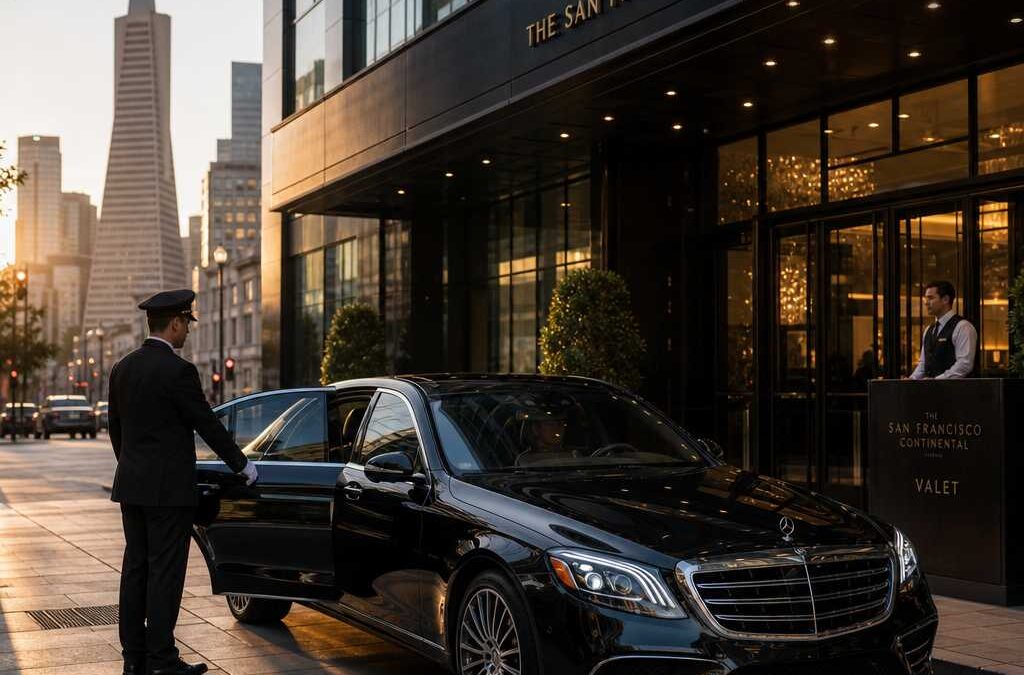
The moment your guest clears customs or walks out of SFO arrivals, they are making a judgment call. Professional VIP client transportation Bay Area service is not a convenience upgrade. It is a signal about how you run your operation. A chauffeur in a pressed suit holding a name placard, tracking the inbound flight in real time, and standing at the correct terminal exit communicates preparation and respect before a single word is exchanged.
Compare that to texting your guest “Uber is on the way” 20 minutes after their plane landed. The contrast is not subtle.
What to look for in a Bay Area chauffeured car service
Not all black car services operate at the same standard. For VIP hosting purposes, the criteria that matter most are flight tracking with automatic schedule adjustment, professional meet-and-greet service at all three major Bay Area airports (SFO, OAK, and SJC), a fleet that matches the profile of your guest, and a flexible cancellation policy for when plans change.
iBlack Limo operates exactly this model, with Mercedes-Benz sedans for solo executives, Cadillac Escalade SUVs for small delegations, and Luxury Sprinter Vans for larger groups. The company’s extended airport wait time policy means your chauffeur does not leave if the flight is delayed. That detail alone removes one of the most common stress points in VIP airport logistics.
Matching the vehicle to the guest’s profile
A Mercedes-Benz sedan signals executive class and privacy. It is the right call for a solo C-suite visitor or a senior partner who values quiet over spaciousness. If your guest is traveling with an assistant, a colleague, or accompanying family, a Cadillac Escalade SUV provides the room and the elevated presence that a sedan cannot. For a delegations of eight to twelve people, a Limo Sprinter keeps the group together without forcing anyone into a cramped van configuration.
“The quality of your hospitality is judged in the first five minutes. Everything after that is either maintaining or recovering from that first impression.” – Robert Cialdini, author of Influence, on first impressions in business relationships
Executive Hosting San Francisco: Dining, Venues, and Experiences
The Bay Area has enough world-class dining and experience options that a generic choice, such as booking the same Marriott ballroom dinner every firm uses, actually works against you. Your guest has likely been to dozens of corporate dinners in hotel event spaces. What they have not done is had a private tasting at a family-owned Sonoma winery followed by a drive back to the city along the coast. That is memorable. The hotel dinner is not.
Dining venues that signal local knowledge
For executive hosting in San Francisco specifically, the neighborhoods and venues that consistently impress out-of-town guests include the Ferry Building waterfront for its combination of setting and culinary quality, the private dining rooms at Bix in the Jackson Square district for a sense of old-world San Francisco, and the chef’s table experiences at several Mission District restaurants for guests who appreciate food culture. Reservations at these venues require lead time, often two to three weeks minimum. Booking the morning before your client arrives is not a strategy.
Experiences beyond the city
Napa Valley and Sonoma are 45 to 90 minutes from San Francisco depending on traffic, which makes them viable for a half-day or full-day excursion. A chauffeured wine tour removes the designated driver problem entirely, allows your guest to engage fully, and keeps the experience at a luxury register throughout. This is one of the most effective executive hosting tools in the Bay Area precisely because it is impossible to replicate in most other markets your client visits.
For guests based in tech, a drive through Silicon Valley with stops in Palo Alto or Cupertino, framed as a tour of the ecosystem rather than a sales trip, often generates more genuine conversation than any conference room meeting. The environment is part of the message.

Pro tip: Call the restaurant directly when booking for a VIP guest and mention the context. Most high-end San Francisco restaurants will note preferred seating, dietary requirements, and arrival time when they know the reservation is for a hosting situation. An email confirmation alone does not trigger this level of service.
Comparing Ground Transportation Options for VIP Visitors
Hosts often ask whether a premium rideshare app qualifies as adequate VIP transportation. The short answer is no, and the reasoning matters. Below is a direct comparison of the three most common options used for executive visitors in the Bay Area.
| Transportation Option | Best Use Case | Key Limitation for VIP Hosting |
|---|---|---|
| Rideshare Premium Tier (Uber Black, Lyft Lux) | Last-minute solo trips within a single city | No flight tracking, variable vehicle quality, no meet-and-greet, driver turnover means no briefing continuity |
| Hotel Concierge Car Service | Single airport pickup arranged by the hotel | Limited fleet options, typically not available for multi-stop itineraries, pricing is usually higher with less flexibility |
| Dedicated Chauffeured Car Service (iBlack Limo) | Full-visit ground transportation from airport arrival through departure | Requires advance booking, but this is a feature not a flaw for VIP hosting where advance planning is already expected |
The data consistently shows that ground transportation is the element of VIP visits that hosts are most likely to underplan. A 2023 Statista report on business travel priorities found that 72% of executive travelers ranked ground transportation reliability as a top-three concern when visiting a new market. Yet most hosts spend 80% of their planning time on the agenda and almost none on how their guest actually moves between appointments.
Pro tip: Book your VIP’s ground transportation for the entire visit, not just the airport pickup. A single chauffeured service handling all movement keeps the experience consistent, eliminates coordination friction between appointments, and gives you one point of contact for any schedule changes.
Managing Multi-Day Visits Across the Bay Area
Multi-day visits require a logistics layer that single-day visits do not. You are now coordinating hotel location relative to meeting sites, transportation across different days with potentially different group sizes, and meal experiences that do not repeat themes or venues. The structural challenge is keeping the visit feeling curated rather than improvised.
Centralize the guest’s base of operations
For visits anchored in San Francisco, hotels in the Financial District or SoMa put your guest within reasonable reach of downtown meetings while remaining accessible from SFO via the Bay. For visits where Silicon Valley meetings dominate, a hotel in Palo Alto or Menlo Park eliminates the 101 commute problem entirely. Do not default to the most famous San Francisco hotel if your guest’s actual meeting schedule is south of the city.
Brief your entire hosting team, not just yourself
A common failure point in multi-day VIP visits is that the primary host has briefed themselves thoroughly while the supporting team, the EA who greets the guest in the lobby, the account manager joining for dinner, the driver, operates on incomplete information. Brief everyone who will have direct contact with your guest on their background, preferences, and any sensitivities. This is not bureaucratic. It is the difference between a visit that feels coordinated and one that feels cobbled together.
With iBlack Limo, you can communicate guest preferences directly to the service team in advance. If your client prefers silence during drives, no promotional conversation about the service, or specific temperature preferences in the vehicle, those details can be noted before the chauffeur arrives at the terminal. That level of customization is simply not available with app-based rideshares.
Have a contingency plan for every major logistics point
Flights get delayed. Restaurant kitchens have fires. Meetings run long. For each critical logistics point in the itinerary, you should have a one-paragraph contingency plan ready: what happens if the flight arrives two hours late, what happens if the 7 PM dinner reservation falls apart, what is the backup if the team meeting runs into the scheduled departure window. Writing these out in advance means you solve the problem once, calmly, rather than in real time while your VIP guest is watching.
Frequently Asked Questions
How far in advance should I book VIP client transportation in the Bay Area?
Book ground transportation as soon as the visit dates are confirmed, ideally two to four weeks out for standard visits. For visits coinciding with large Bay Area conferences, such as Dreamforce, Oracle OpenWorld, or major tech product announcements, book even earlier. Premium chauffeured services like iBlack Limo have finite fleet capacity, and waiting until the week before a major event means accepting whatever is available rather than what is appropriate for your guest.
Which Bay Area airport should I route my VIP guest through?
SFO is the default for most international and cross-country flights, and it offers the widest choice of direct routes. SJC is the better option when the majority of meetings are in Silicon Valley, since it eliminates the Peninsula commute entirely. OAK can work for East Bay-focused visits but requires crossing the Bay Bridge, which adds significant time uncertainty during peak hours. The airport choice should match where the guest will spend most of their time, not which airport has the most flights.
Is a chauffeured car service meaningfully different from Uber Black for executive hosting?
Yes, in several material ways. A professional chauffeured service tracks inbound flights and adjusts pickup timing automatically, maintains extended wait times so your guest is never standing at the curb, and allows you to brief the driver on your guest’s preferences in advance. Uber Black uses a rotating pool of drivers with no continuity between rides and no mechanism for pre-trip guest briefing. For a one-off solo trip, the difference may feel minor. For a two-day VIP visit where ground transportation touches every itinerary item, the difference is significant.
What vehicle should I book for a VIP delegation of four executives?
A Cadillac Escalade SUV is the right call for a group of three to four. It provides premium seating for everyone, sufficient luggage capacity for business travel bags, and the right visual register for executive hosting. A standard sedan forces someone into a compromised seat position, which matters on longer Bay Area drives. If the delegation is five to eight people and you want to keep the group together, a Luxury Sprinter Van from a service like iBlack Limo is the appropriate step up.
What are the most effective non-dining experiences for Bay Area VIP hosting?
A chauffeured Napa or Sonoma wine tour consistently ranks as the highest-impact experience for executive guests who are visiting the Bay Area for the first time or second time. It is geographically specific, genuinely impressive, and creates conversation and memory in a way that a dinner reservation cannot. For repeat visitors, a coastal drive to Monterey or a private sailing experience on the Bay provides variety. The rule of thumb is to choose experiences that cannot be replicated in Chicago, New York, or London, the cities your guest likely visits most often.
How should I handle a VIP guest’s schedule if their flight is significantly delayed?
A professional car service that tracks flights in real time, such as iBlack Limo, will automatically adjust the pickup window without requiring you to call and re-coordinate. On your end, the delay protocol should be: notify the hotel for a flexible late check-in, contact the dinner reservation to push by 90 minutes if possible, and send your guest a brief message confirming the car is still tracking them and the evening is adjusted. Do not bombard them with logistics updates during the flight. One message confirming everything is handled is sufficient and more reassuring than three anxious check-ins.
Have you hosted a VIP client visit in the Bay Area recently? We would love to hear what worked and what caught you off guard, leave a comment below or share your experience with the iBlack Limo team.
References
- Forbes: Business leadership and executive relationship management insights
- Statista: Business travel priorities and ground transportation reliability data
- HubSpot: Research on client experience and its impact on executive-level purchasing decisions
- McKinsey and Company: Analysis of B2B client relationship management and visit ROI
- Skift: Corporate travel trends and VIP ground transportation standards in major U.S. markets