
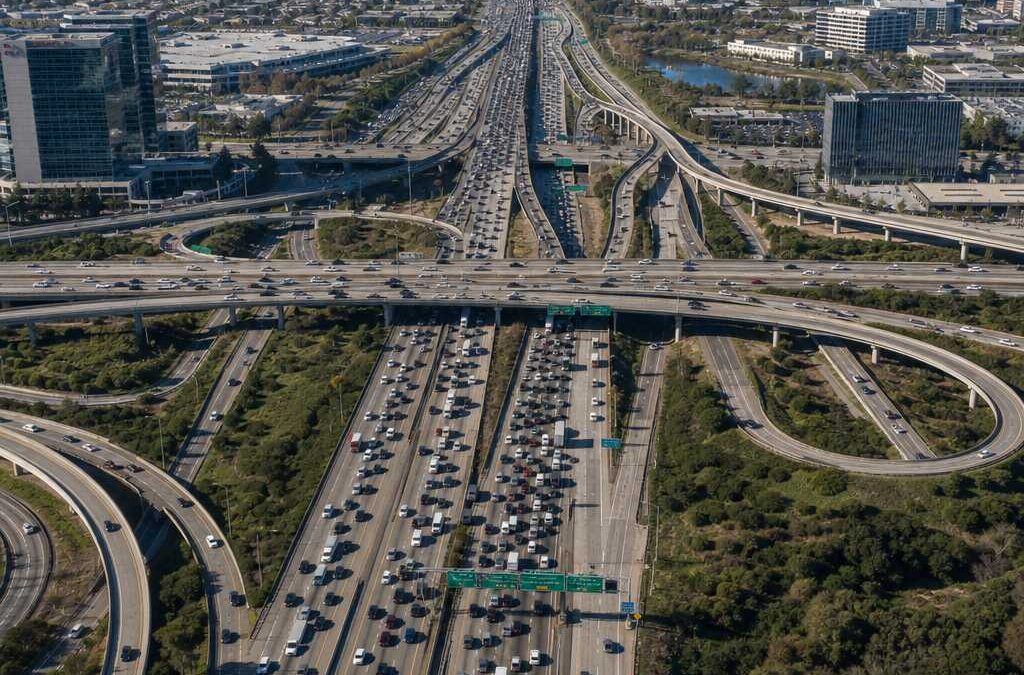
A corporate roadshow Bay Area event sounds straightforward until your executive is stranded on the 101 between Palo Alto and San Francisco because the rideshare app surged at the worst possible moment. The Bay Area is one of the most logistically complex metro regions in the country, with five major business corridors, three commercial airports, and traffic patterns that punish any plan built on optimism rather than precision. Pulling off a multi-stop roadshow here requires the kind of ground transportation strategy most companies do not think about until something goes wrong. This guide is built around what actually works.
Table of Contents
- Quick Takeaways
- Why Bay Area Roadshows Fail Before They Start
- Mapping Your Route Across the Bay Area’s Business Corridors
- Choosing the Right Ground Transportation for Each Leg
- Airport Transfers and Timing: SFO, OAK, and SJC
- Comparing Your Bay Area Roadshow Transportation Options
- Managing Schedule Changes Without Losing the Day
- Group Travel and Multi-Executive Logistics
- Frequently Asked Questions
- References
Quick Takeaways
| Key Insight | Explanation |
|---|---|
| Build 30-minute buffers at every crossing point | Bay Bridge and 101 corridor delays are unpredictable. A missed meeting at meeting number two ruins the entire day, not just one slot. |
| Assign one dedicated chauffeur per executive when possible | Swapping drivers mid-roadshow creates communication gaps and security concerns, especially for C-suite executives carrying confidential materials. |
| Pre-book chauffeured vehicles, not ride-share apps | Surge pricing, driver no-shows, and inconsistent vehicle quality make ride-share a liability for professional roadshows. |
| Vehicle size should match group size exactly | Overpaying for a mini coach when a Sprinter van works, or cramming six people into a sedan, both signal poor planning to clients. |
| Track inbound flights before airport pickups | Early arrivals matter as much as delays. A chauffeur who is not tracking the flight will not be curbside when the executive lands 20 minutes early. |
| Confirm each stop with the hosting party 24 hours out | Bay Area companies reschedule constantly. A confirmation call catches cancellations before your executive is sitting in a lobby. |
| Brief your chauffeur on the full itinerary, not just the first stop | A chauffeur who knows all six stops can flag timing conflicts before they become problems, not after. |
Why Bay Area Roadshows Fail Before They Start

The most common failure in Bay Area roadshow planning is treating it like a calendar problem rather than a logistics problem. Executives and their assistants block the meetings, confirm the rooms, and then book a car service the morning before. That sequence is backwards.
Ground transportation in the Bay Area is not a commodity. The distance between a San Francisco financial district meeting and a Menlo Park office park looks manageable on a map. In practice, that same route during morning drive or late afternoon can consume 75 to 90 minutes, not 35. The 101, 280, and Highway 85 all perform differently depending on the hour, and the Bay Bridge backup can add unpredictable time to any cross-bay segment.
The executives who have the smoothest roadshows are the ones whose teams built the transportation plan first and scheduled meetings around realistic drive windows, not the other way around. According to McKinsey research on executive productivity, senior leaders lose up to 28 percent of their working hours to scheduling friction and avoidable logistics failures. A poorly planned roadshow amplifies that loss in a single day.
“Time is the scarcest resource of the executive, and unless it is managed, nothing else can be managed.” Peter Drucker, as cited in Harvard Business Review’s classic study on executive time use.
A common mistake is assuming that a roadshow across Silicon Valley is easier than one that crosses the bay. Palo Alto to San Jose to Campbell and back up to Mountain View can easily eat a full day with parking, security check-ins, and lobby wait times factored in. Build your schedule with those friction points in mind from the beginning.
Mapping Your Route Across the Bay Area’s Business Corridors
The Bay Area has five distinct business corridors that most corporate roadshows touch. Each one has different traffic characteristics, parking constraints, and logistical needs that should shape your route design.
San Francisco Financial District and SoMa
The Financial District and South of Market area are dense, parking-hostile, and dependent on precise curbside pickup timing. Drop-off and pickup in these areas require a chauffeur who knows which streets are one-way, which blocks restrict commercial vehicles during peak hours, and where a car can legally hold for five minutes without getting ticketed or towed.
If your roadshow includes multiple stops in SF itself, cluster them geographically. Jumping from the Embarcadero to Salesforce Tower to a SoMa startup is manageable. Jumping from the Embarcadero to Mission Bay to the Richmond District in a single morning is not, unless you have allocated realistic drive and parking time for each leg.
Silicon Valley: Palo Alto, Menlo Park, Mountain View, and San Jose
The Peninsula and South Bay corridor is more car-friendly but deceptively spread out. Tech campuses are often large, require badging, and have multiple entrance gates. A chauffeur dropping off at the wrong entrance of a large corporate campus can cost 15 minutes in rerouting alone. Brief your transportation provider with the specific entrance address, not just the company name.
For roadshows that span Palo Alto to San Jose in a single day, plan no more than four to five meetings. That is not pessimism. That is based on realistic transit times once you account for campus access, meeting overruns, and the Mathilda to 101 interchange around noon.
East Bay: Oakland, Emeryville, and Walnut Creek
Cross-bay segments deserve their own risk buffer. If your roadshow includes both SF and Oakland stops, the Bay Bridge westbound in the afternoon is one of the most reliably congested segments in the state. Build a 45-minute minimum buffer for any Bay Bridge crossing after 3:00 PM. The Webster Tube and San Mateo Bridge are viable alternates depending on the destination, and a knowledgeable chauffeur will know when to use them.
Pro tip: If your roadshow spans San Francisco and the East Bay on the same day, sequence the East Bay meetings in the morning and return to SF for afternoon meetings. Fighting the bridge in the westbound direction at 4:30 PM is a guaranteed schedule breaker.
Choosing the Right Ground Transportation for Each Leg
Vehicle selection is not about comfort preferences. It is about matching capacity, discretion, and function to the specific meeting context. A solo CFO heading to a confidential investor meeting does not need a Sprinter van. A team of eight heading to an all-day client summit should not be squeezed into two sedans.
Solo Executives and Confidential Meetings
For single executives or two-person delegations, a Mercedes-Benz sedan delivers the combination of professional presentation and cabin privacy that matters in a roadshow context. The quiet cabin doubles as a mobile workspace. Executives regularly use drive time to review pitch decks, conduct calls, and decompress between high-pressure meetings. That only works if the vehicle is appropriate for the task.
Small Groups and Leadership Teams
For groups of three to six, a Cadillac Escalade SUV provides the space for a small leadership team to travel and talk without the awkward logistics of multiple sedans. It also signals the right level of professionalism to hosting companies who may see your vehicle arrive. In the Bay Area tech world, that visual cue matters more than most people admit.
Larger Delegations and Multi-Team Roadshows
Groups of seven or more need a different solution. The 14-Passenger Luxury Sprinter Van or the 12-Passenger Limo Sprinter from iBlack Limo handle larger delegations without sacrificing the quality that a corporate roadshow demands. For roadshows involving 20 or more people, including visiting executive delegations or investor day tours, the 28-Passenger Mini Coach allows the full group to travel together, keeping briefings and conversations unified rather than fragmented across multiple vehicles.
Pro tip: For multi-team roadshows where different executives have different schedules on the same day, coordinate a base vehicle for the primary delegation and a sedan for the executives breaking off for private meetings. iBlack Limo can handle both simultaneously with matched chauffeurs briefed on the full itinerary.

Airport Transfers and Timing: SFO, OAK, and SJC
Almost every Bay Area corporate roadshow starts or ends at an airport. Getting this segment right is non-negotiable because a missed pickup at SFO can cascade into a blown first meeting, a rattled executive, and a roadshow that never recovers its rhythm.
SFO Pickup Strategy
San Francisco International is the most complex of the three Bay Area airports for ground transportation. The international terminal and domestic terminals require different pickup approaches. Professional chauffeur services use meet-and-greet protocols, meeting the executive inside at baggage claim with a name sign rather than waiting curbside. This matters because SFO’s curbside situation is high-volume and high-stress, and executives should not be navigating that after a six-hour cross-country flight.
iBlack Limo tracks inbound flights in real time at SFO, OAK, and SJC. If a flight lands 22 minutes early, the chauffeur adjusts. If it is delayed, the chauffeur is updated before they leave for the airport. Extended wait time is included, not charged as a penalty. That is a structural difference from most transportation options.
SJC for Silicon Valley-Focused Roadshows
If the roadshow is entirely South Bay-centric, San Jose International is dramatically more practical than SFO. The airport is smaller, faster to exit, and positions an executive within 15 to 25 minutes of most major tech company headquarters in Santa Clara, Sunnyvale, and San Jose. Flying into SFO for a roadshow centered in Mountain View and Cupertino adds unnecessary complexity.
OAK for East Bay and SF Meetings
Oakland International is underused by corporate travelers and is often a better option for East Bay-heavy roadshows or when SFO is experiencing weather-related delays. The drive time from OAK to downtown SF is comparable to SFO in most non-peak conditions, and the airport is significantly less congested.
Comparing Your Bay Area Roadshow Transportation Options
| Option | Best Use Case | Key Limitation |
|---|---|---|
| Ride-Share Apps (Uber/Lyft) | Ad hoc, single trips with no schedule dependency | Surge pricing, inconsistent vehicle quality, no flight tracking, driver reliability unknown |
| Rental Car with Executive Driver | Multi-day roadshows where one driver stays with one executive | Requires extensive vetting, no fleet support if vehicle breaks down, no backup coordination |
| Professional Chauffeured Car Service (iBlack Limo) | Full-day or multi-day Bay Area roadshows with multiple executives, airport transfers, and varying group sizes | Requires advance booking, which is actually an advantage for planning discipline |
The data consistently shows that companies using professional chauffeured car services for executive roadshows report significantly fewer schedule disruptions than those using ad-hoc transportation. According to Statista’s 2023 business travel data, ground transportation failures are among the top three causes of disrupted business travel itineraries. The fix is not complicated. It is pre-commitment to a reliable provider.
Managing Schedule Changes Without Losing the Day
Bay Area companies reschedule. Investors push meetings. Portfolio company CEOs have fires to put out. A roadshow built with zero flexibility will collapse the moment one meeting shifts by 45 minutes. The goal is building a schedule that can absorb a single disruption without triggering a cascade.
The most effective technique is scheduling a deliberate gap of 30 to 45 minutes at the midpoint of the day. Frame it internally as a working break. In practice, it is your schedule’s shock absorber. If the morning runs on time, the executive uses it for calls or prep work in the car. If the morning runs long, that buffer absorbs the overrun without touching afternoon meetings.
Communicate itinerary changes to your transportation provider immediately. A professional chauffeur service like iBlack Limo can reroute, adjust arrival times, and coordinate across multiple vehicles in real time, but only if they receive the updated information. Texting your assistant who then calls the booking office two hours later is too slow. Establish a direct communication channel with your ground transportation coordinator before the roadshow begins.
iBlack Limo’s flexible cancellation policies also matter here. If a meeting is dropped from the schedule entirely, you need a provider whose terms do not penalize reasonable adjustments made with reasonable notice. That is part of what distinguishes a purpose-built executive transportation San Francisco service from a generic car rental or app-based option.
Group Travel and Multi-Executive Logistics
The most complex Bay Area roadshows involve multiple executives traveling on overlapping but distinct schedules. A managing director may have two private one-on-ones while the broader team attends a group presentation across town. Coordinating that without a coherent ground transportation plan creates the kind of confusion that is visible to clients and embarrassing for the company.
Assigning Dedicated Vehicles by Executive Track
When two or more executives are traveling different sub-itineraries, assign each track a dedicated vehicle and chauffeur. Brief each chauffeur on the other track’s schedule so they are aware of rendezvous points, shared hotel locations, or end-of-day coordination logistics. A chauffeur service that operates a proper fleet, rather than a single operator, can coordinate this internally.
Using Shared Vehicles for Group Segments
When the full delegation travels together, such as to a keynote presentation, a client dinner, or an investor summit, consolidating into a single larger vehicle has practical advantages. It keeps the team together for briefing conversations, eliminates the split-arrival awkwardness, and presents a unified arrival to the hosting organization.
iBlack Limo’s fleet covers every group size from a solo executive in a Mercedes-Benz sedan to a 28-person delegation in the Mini Coach, which means a single provider can handle the entire roadshow without handing off coordination to a second company mid-event. That continuity matters when something goes wrong and you need one point of contact to resolve it.
For roadshows that include wine country or Napa Valley events as part of an investor or client entertainment segment, the same provider handles that leg without requiring a separate booking. The chauffeured car service corporate model works precisely because the provider understands the full scope of executive travel, not just airport-to-hotel transfers.
Pro tip: For multi-day Bay Area roadshows, request the same chauffeur for the same executive across all days if possible. By day two, the chauffeur knows the executive’s preferences, communication style, and schedule rhythm. That continuity reduces friction significantly.
Frequently Asked Questions
How far in advance should I book chauffeured transportation for a Bay Area corporate roadshow?
Book at minimum 48 to 72 hours in advance for single-vehicle needs. For multi-vehicle roadshows involving executive delegations, book one to two weeks ahead. Bay Area corporate events cluster around earnings seasons, major tech conferences like Dreamforce and Google Cloud Next, and fiscal quarter ends. Fleet availability during those windows tightens quickly, and last-minute bookings result in either unavailability or suboptimal vehicle assignments.
Is it worth booking a chauffeured service for short trips within San Francisco?
Yes, especially for roadshows where the executive cannot afford to be late, distracted by navigation, or arriving in an inconsistent vehicle. Short distances in SF are not short in time. A two-mile trip from the Embarcadero to SoMa during lunch can take 20 minutes in traffic. A chauffeur who knows the city’s flow and parking constraints handles that without involving the executive at all. That mental load matters across a full roadshow day.
How does flight tracking work with airport pickup services?
A professional chauffeured service monitors the executive’s inbound flight using the flight number provided at booking. If the flight is early, the chauffeur leaves earlier. If delayed, the dispatch adjusts the chauffeur’s departure time and updates the pickup accordingly. iBlack Limo builds extended wait time into airport pickups so the executive is never standing at baggage claim waiting for a car that has not arrived yet.
What vehicle should a team of eight use for a full-day Silicon Valley roadshow?
A 14-Passenger Luxury Sprinter Van is the right choice for a team of eight on a full-day roadshow. It provides enough space that the team can work, debrief, and prepare during transit rather than sitting in silence. It also eliminates the coordination overhead of managing two sedans on the same itinerary with different drivers.
How should I handle it if a meeting runs significantly over schedule?
Notify your chauffeur or transportation coordinator immediately when the overrun becomes apparent, not when you are walking out the door. A good chauffeur service will adjust the route, notify downstream stops if necessary, and give you an honest assessment of whether the next meeting is still achievable. The worst outcome is discovering 30 minutes too late that the next meeting should have been rescheduled. Communication is the fix, and it requires a transportation partner who is reachable and responsive throughout the day.
Can the same chauffeured service handle both airport transfers and all-day roadshow driving?
Yes, and this is the preferred approach. Using one provider for the airport pickup and a separate one for the roadshow day creates a handoff point where things go wrong. A single provider who handles the full journey, from SFO arrival through all six meetings to the hotel drop-off, maintains continuity, knows the full schedule, and can problem-solve holistically when disruptions occur.
If you have run a Bay Area corporate roadshow recently, share what worked and what you would change about your ground transportation plan. Real-world experience from other planners and executive assistants is the most useful resource for getting this right.
References
- McKinsey and Company research on executive productivity and time allocation in large organizations
- Statista business travel data and ground transportation disruption statistics for corporate travelers
- Harvard Business Review analysis of how senior executives manage and protect their working time
- Forbes coverage of corporate roadshow best practices and investor relations travel planning
- Global Business Travel Association industry data on executive ground transportation preferences and standards