
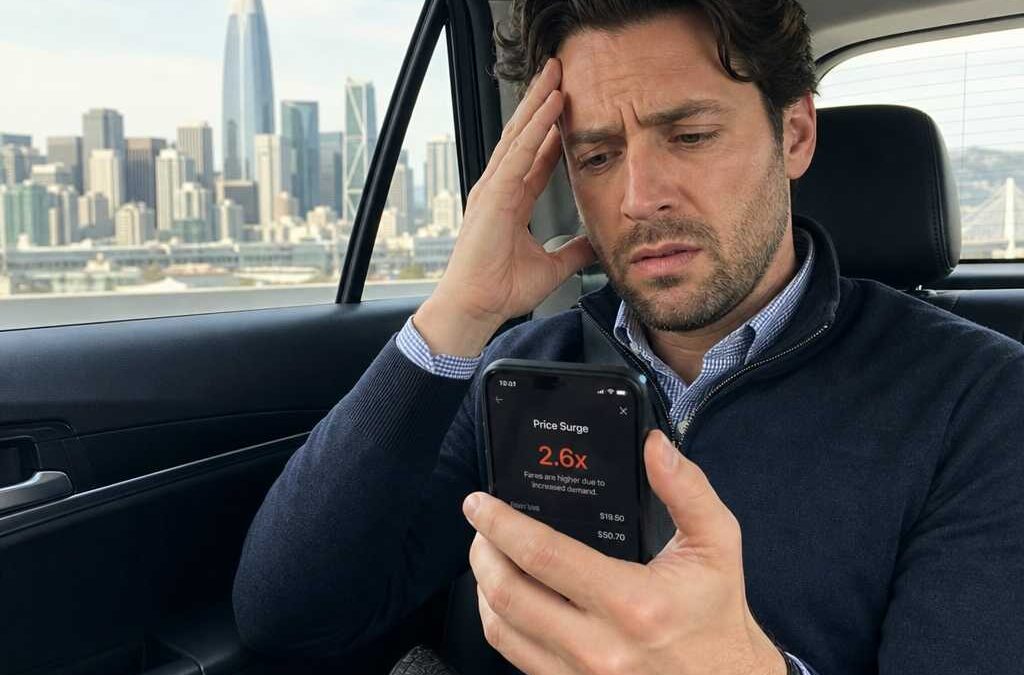
If you are a frequent business traveler in the Bay Area, you have probably convinced yourself that Uber and Lyft are the smart, affordable choice. The numbers rarely support that assumption. Surge pricing during peak SFO departure windows, no-show drivers at critical moments, and expense reports that trigger finance department audits are just the beginning. When you do a real rideshare vs black car Bay Area comparison that accounts for every dollar, the rideshare “savings” often disappear entirely, and the hidden costs go well beyond your credit card statement.
Table of Contents
- Quick Takeaways
- The Real Price of Surge Pricing in the Bay Area
- Time Costs That Never Appear on Your Receipt
- The Expense Reporting Trap for Corporate Travelers
- Reliability and the Cost of a Missed Flight
- Rideshare vs Black Car Service: A Side-by-Side Comparison
- What Corporate Travel Managers Actually Track
- Frequently Asked Questions
- References
Quick Takeaways
| Key Insight | Explanation |
|---|---|
| Surge pricing at SFO can triple base fares | During peak morning departures and evening arrivals, Uber and Lyft surge multipliers at SFO regularly hit 2.5x to 3x, making a standard San Francisco to airport ride cost $90 or more with no quality guarantee. |
| Driver no-shows carry a real business cost | A rideshare no-show or last-minute cancellation before a flight costs more than a rebooking fee. It costs credibility, stress, and often an entirely missed meeting or connection. |
| Expense reconciliation adds hidden labor time | Rideshare receipts are inconsistent, split across personal apps, and frequently flagged by corporate finance teams. A dedicated black car invoice is clean, itemized, and billable in minutes. |
| Productivity is lost in rideshare vehicles | Standard rideshare cars are not designed for working. A chauffeured Mercedes-Benz sedan or Sprinter van gives executives quiet, reliable connectivity time that translates to real output. |
| Black car pricing is predictable; rideshare pricing is not | Fixed-rate corporate car service eliminates budget uncertainty. Finance teams can forecast ground transportation costs accurately, unlike rideshare which fluctuates with demand algorithms. |
| Client impression carries a dollar value | Arriving to a client meeting in a professionally chauffeured vehicle versus being dropped at the curb from a stranger’s Prius signals different things. In high-stakes business contexts, that difference has measurable value. |
| Airport wait time policies differ dramatically | Rideshare drivers circle and leave. A chauffeured car service like iBlack Limo tracks your flight in real time and waits at no extra charge, eliminating the scramble on delayed arrivals. |
The Real Price of Surge Pricing in the Bay Area
The Bay Area is one of the most dynamic rideshare pricing environments in the United States. Demand surges at San Francisco International Airport during morning departures between 6 a.m. and 9 a.m., at San Jose Mineta Airport during Silicon Valley commuter rushes, and across the peninsula whenever a major tech conference or sporting event is in session. The algorithm does not care about your budget or your schedule.
In practice, a standard sedan ride from downtown San Francisco to SFO sits around $35 to $45 at off-peak times. That same ride during a surge event can climb to $80, $100, or higher. According to data published by Statista, ride-hailing prices in the United States increased over 40% between 2019 and 2023, driven by driver supply constraints and algorithmic demand pricing. For a business traveler making three to four airport runs per week, that variance creates a significant unbudgeted expense.
The deeper problem is that surge pricing is highest precisely when you need reliability most: early morning flights, late arrivals after delayed connections, and high-traffic event days in San Francisco and Silicon Valley. A fixed-rate corporate car service eliminates this completely. When you book with iBlack Limo, the price you see is the price you pay, regardless of what Uber’s algorithm is doing that morning.
Pro tip: If you are a frequent SFO or SJC traveler and your ground transportation bill varies by more than 30% month to month, surge pricing is almost certainly the cause. Track three months of rideshare receipts against your travel calendar and compare the pattern.


Time Costs That Never Appear on Your Receipt
Rideshare apps show you a price. They do not show you the ten minutes you spent standing on a San Francisco curb waiting for a driver who accepted your ride from three miles away. They do not show the cost of the call you could not take because your driver had talk radio on at full volume. And they certainly do not show the value of the email thread you could have resolved in a quiet, professionally appointed vehicle.
McKinsey research on executive productivity consistently shows that uninterrupted focus time is among the scarcest and most valuable resources for senior professionals. A standard rideshare ride offers none of the conditions needed for productive work: no consistent quiet, no guaranteed phone signal quality, and no expectation of privacy for sensitive conversations.
The Commute-as-Workspace Opportunity
Corporate travelers who ride in a chauffeured vehicle regularly describe the same pattern: they arrive at their destination having completed tasks, rather than arriving depleted from a stressful pickup process. Whether it is a 45-minute ride from a Palo Alto office to SFO or a transfer from a San Jose hotel to a board meeting in San Francisco, a professionally chauffeured vehicle converts dead time into working time.
iBlack Limo’s Mercedes-Benz sedans and Cadillac Escalade SUVs are maintained specifically for executive use. Climate control, quiet interiors, and a professional driver who understands that silence is a service, not a failure, make the difference between arriving prepared and arriving frazzled.
Pro tip: When presenting ground transportation as a business expense to your finance team, calculate the hourly cost of your time and multiply it by the productive hours lost to unreliable rideshare experiences each month. The math typically justifies the upgrade immediately.
The Expense Reporting Trap for Corporate Travelers
Ask any corporate travel manager at a Bay Area tech company or law firm about rideshare expense reports, and you will hear the same frustrations. Receipts arrive in a personal email. Line items say only “Uber Trip” with no destination detail. Personal and business rides are mixed on the same account. Finance flags the entire batch for review.
According to the Global Business Travel Association, expense report processing costs companies an average of $58 per report when errors require manual correction. For a team of ten executives each submitting weekly reports, that friction compounds fast across a quarter. The root cause is not the employees. It is that rideshare apps are designed for consumers, not corporate billing workflows.
“The true cost of a business trip is never just the fare. It includes the administrative overhead of processing, auditing, and reconciling every receipt. Inconsistent rideshare data creates disproportionate administrative burden.” Global Business Travel Association, 2023 Business Travel Report
A corporate car service account with iBlack Limo produces clean, itemized invoices tied to specific trips, dates, passengers, and routes. These drop directly into a corporate billing workflow without requiring personal credit cards, personal apps, or manual data entry. For finance teams managing ground transportation at scale across a San Francisco or Silicon Valley operation, that is a structural advantage, not just a convenience.

Reliability and the Cost of a Missed Flight
The single most expensive rideshare cost is the one that happens infrequently enough that travelers rationalize it away. A missed flight due to a no-show driver, a last-minute cancellation, or a driver who accepted the ride but took 25 minutes to arrive costs $300 to $800 in rebooking fees alone, not counting the business consequence of missing a meeting, a closing call, or an investor presentation.
This is not a hypothetical. Rideshare cancellation rates are a documented industry problem. A 2022 study cited by Forbes found that nearly one in five rideshare requests in major U.S. cities experienced either a cancellation or a wait time exceeding 10 minutes during peak demand. In the Bay Area, where peak demand at SFO and SJC regularly aligns with critical business departure windows, this is an active operational risk.
How Flight Tracking Changes the Equation
iBlack Limo monitors your incoming flight in real time. If your SFO arrival is delayed by 40 minutes, your chauffeur already knows before you land and adjusts accordingly. No extra charge. No scrambling to re-request. No hoping the app will find you another driver at 11 p.m. when your flight finally touches down.
This is the specific difference between a consumer app and a professional chauffeured car service. The former is a marketplace that routes supply to demand. The latter is a dedicated service relationship built around your schedule and your itinerary.
Rideshare vs Black Car Service: A Side-by-Side Comparison
The table below compares rideshare apps (Uber and Lyft) against iBlack Limo’s chauffeured car service across the variables that matter most to frequent Bay Area business travelers. Generic “price per mile” comparisons miss most of the story. This one does not.
| Factor | Rideshare Apps (Uber / Lyft) | iBlack Limo Chauffeured Service |
|---|---|---|
| Pricing model | Dynamic, algorithm-driven, surge pricing applies at SFO, SJC, and SFO event days | Fixed-rate, pre-confirmed pricing with no surge charges regardless of demand |
| Driver reliability | Consumer marketplace, cancellations common during peak hours | Dedicated professional chauffeur assigned to your booking, confirmed in advance |
| Airport pickup process | Curb scramble, variable wait zones, driver circles and leaves after 5 minutes | Meet-and-greet inside terminal with name sign, extended wait included, flight tracking active |
| Vehicle quality | Variable, driver’s personal vehicle, no quality guarantee | Curated fleet including Mercedes-Benz sedans, Cadillac Escalade SUVs, Sprinter vans |
| Corporate billing | Personal app, personal credit card, manual receipt reconciliation | Corporate account invoicing, clean itemized records, no personal card required |
| Confidentiality | No privacy standard, conversations in presence of unvetted strangers | Professionally trained chauffeurs operating under strict discretion standards |
| Group travel | Multiple ride requests, multiple receipts, coordination overhead | Single booking for groups via Sprinter van or Mini Coach, single invoice |
What Corporate Travel Managers Actually Track
At companies like Salesforce, Google, and the major law firms anchored in San Francisco’s Financial District, corporate travel managers do not evaluate ground transportation by base fare alone. They track total cost of travel, which includes the employee’s time, the expense processing overhead, reimbursement error rates, and the risk exposure from unreliable transport on critical travel days.
The data consistently shows that companies switching from ad-hoc rideshare to managed corporate car service accounts reduce their ground transportation spend variance significantly. Predictable costs mean predictable budgets. A finance team that can forecast ground transportation within 5% accuracy will always prefer that over monthly rideshare bills that swing 40% based on surge events and travel frequency.
The Total Cost of Travel Framework
Corporate travel managers at mid-to-large Bay Area companies use a total cost framework that includes five categories: base fare, time cost of the traveler, administrative processing cost, risk cost of missed connections or delays, and client impression value. When you run this framework honestly, rideshare apps are competitive only on the first category. They lose on the other four.
iBlack Limo is specifically positioned to serve this framework. For companies running roadshows out of San Francisco, shuttling executives between Silicon Valley offices and SFO, or transporting visiting clients across the Bay Area, a managed account with a professional car service is not a luxury line item. It is an operational decision that reduces total cost while increasing reliability and professional image.
Pro tip: If your company books ground transportation for five or more executives regularly, ask iBlack Limo about a corporate account structure. Fixed-rate invoicing, priority dispatch, and a single point of contact eliminate the coordination chaos that comes with everyone booking their own apps independently.
Frequently Asked Questions
How much more expensive is a black car service compared to Uber in the Bay Area?
At off-peak times, a standard Uber ride from San Francisco to SFO might cost $35 to $45. A chauffeured sedan from iBlack Limo to the same destination runs at a fixed rate in a comparable range, without surge risk. During peak hours, the Uber price frequently exceeds the fixed black car rate once surge multipliers are applied. For frequent business travelers, the total monthly cost difference is often smaller than assumed, and the reliability and productivity value is substantially higher with a professional chauffeured service.
Do rideshare apps work well for early morning flights out of SFO or SJC?
In practice, early morning rideshare availability in the Bay Area is one of the highest-risk scenarios for business travelers. Driver supply is lowest between 4 a.m. and 6 a.m., and cancellations during this window are common. For any flight where missing the departure has real business consequences, a pre-booked chauffeured service with a confirmed driver is the only rational choice.
What makes corporate car service billing easier than rideshare for Bay Area companies?
Rideshare billing runs through personal accounts and personal apps, creating reconciliation friction for finance teams. A corporate account with iBlack Limo produces consistent, itemized invoices per trip, linked to a central billing relationship rather than individual employee accounts. This eliminates reimbursement processing delays and reduces the audit exposure that comes with mixed personal and business rideshare usage.
Is a chauffeured car service worth it for shorter Bay Area trips, not just airport transfers?
Yes, for several trip types. Executive transfers between Silicon Valley offices and San Francisco, client pickups from hotels in the Financial District, roadshow transport between investor meetings, and wine country or Napa client events all benefit from the professionalism, privacy, and reliability of a dedicated chauffeured vehicle. The value is not limited to airport runs.
How does iBlack Limo handle flight delays differently from rideshare apps?
iBlack Limo actively monitors incoming flights for all airport pickups. When your SFO, OAK, or SJC arrival is delayed, your chauffeur is already informed and your wait time is adjusted at no additional charge. A rideshare app, by contrast, requires you to rebook on arrival, compete for surge-priced vehicles with other delayed passengers, and hope a driver is nearby. The operational difference is significant, especially on late-night or early-morning arrivals.
Can rideshare apps be used for group business travel across the Bay Area?
Technically yes, but the coordination overhead is considerable. Multiple vehicles, multiple bookings, multiple receipts, and no guarantee all vehicles arrive together makes rideshare a poor choice for group corporate travel. iBlack Limo’s 14-passenger Luxury Sprinter, 12-passenger Limo Sprinter, and 28-passenger Mini Coach handle groups in a single booking, with a single invoice, and a single professional point of contact.
What has been your experience comparing rideshare and chauffeured car service costs as a Bay Area business traveler? Share your perspective below.
References
- Statista, ride-hailing pricing trends and market data for the United States transportation sector
- Forbes, business travel cost analysis and corporate ground transportation spending reports
- McKinsey and Company, executive productivity research and the economics of business travel time
- Global Business Travel Association, annual business travel expense benchmarking and corporate ground transportation data
- U.S. Bureau of Transportation Statistics, commercial airport passenger volume and ground transportation demand data