
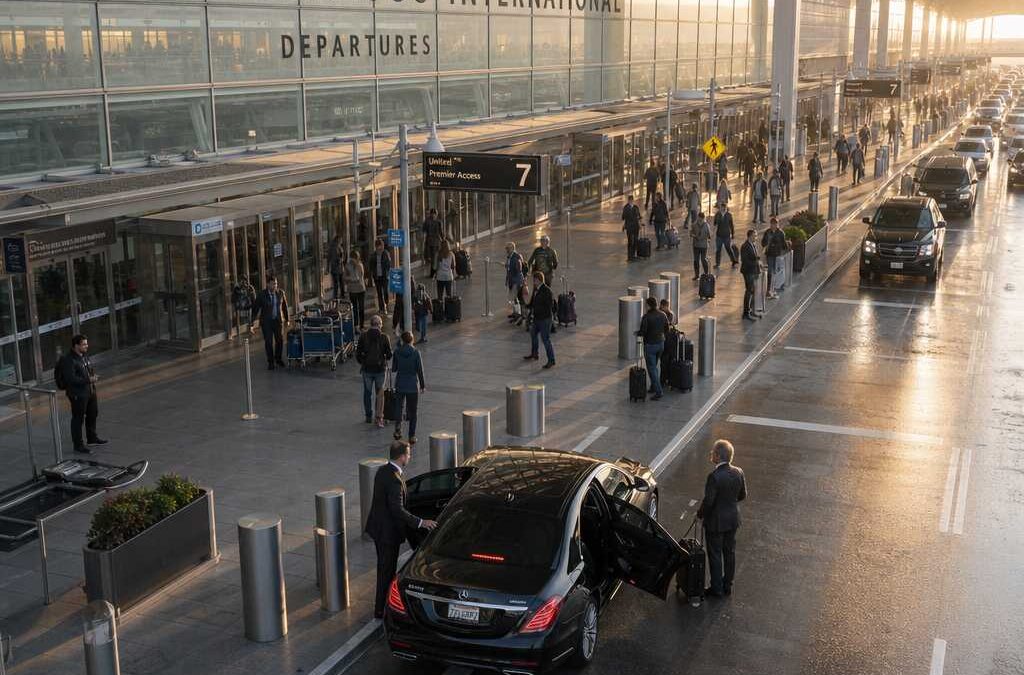
You land at SFO after a red-eye or a transatlantic flight, your first meeting is in two hours, and your phone is showing a 45-minute Uber surge. This is the exact moment inbound executive travel San Francisco either goes smoothly or falls apart. The Bay Area is not a city you can navigate on improvisation, particularly if you have back-to-back meetings in San Francisco, a dinner in Palo Alto, and a morning flight out of SJC. This guide cuts through the noise and tells you exactly how to move around the Bay Area with the efficiency and discretion your schedule demands.
Table of Contents
- Why Standard Ground Transport Fails Visiting Executives
- Quick Takeaways
- Airport Arrivals: The First 30 Minutes Matter Most
- Navigating San Francisco Neighborhoods for Business
- The Silicon Valley Corridor: What Visiting Executives Get Wrong
- Comparing Transport Options for Bay Area Executives
- Wine Country and Off-Campus Executive Events
- How to Brief Your Chauffeur for Maximum Efficiency
- Frequently Asked Questions
- References
Why Standard Ground Transport Fails Visiting Executives
San Francisco traffic is genuinely unpredictable in ways that differ from other major U.S. cities. The combination of narrow one-way streets, aggressive construction zones, and the Bay Bridge bottleneck means that a 4-mile trip from the Financial District to SFO can range from 20 minutes to over an hour depending on the time of day and day of the week.
Rideshare apps operate on a reactive model. They send you a driver after you request one. For an executive with a hard departure time or a client waiting in a lobby, reactive transport is a liability, not a convenience.
Visiting executive car service solves this by building lead time into the entire logistics chain. Your driver monitors your inbound flight, adjusts pickup timing if there is a delay, and knows your preferred route before you clear customs. The difference is not luxury for its own sake. It is operational reliability.
Quick Takeaways
| Key Insight | Explanation |
|---|---|
| SFO has three distinct terminal zones with different pickup logistics | International arrivals, domestic terminals, and the AirTrain connector each have different meetup points. A chauffeur pre-positioned at the right terminal saves 15-25 minutes versus curbside rideshare. |
| The Financial District, SoMa, and Mission Bay are the three executive business hubs | Most San Francisco corporate meetings happen in these three zones. Knowing the traffic patterns between them determines whether your schedule holds together. |
| Silicon Valley is not a single place | A meeting at Google in Mountain View and a meeting at Apple in Cupertino are 12 miles apart. Multi-stop itineraries require a dedicated vehicle, not sequential rideshare bookings. |
| SJC is often the smarter airport for South Bay meetings | Executives flying into SFO for a full day in Silicon Valley often waste 90 minutes in transit each way. SJC drops you 20 minutes from most major tech campuses. |
| Napa and Sonoma corporate events require advance planning | Wine country is a 1.5-to-2-hour drive from San Francisco. A dedicated sprinter or SUV for a group of 6 to 14 executives is far more cost-effective than a fleet of sedans. |
| Flight tracking is standard with premium chauffeur services | iBlack Limo monitors your flight in real time and adjusts pickup timing automatically. You are never standing at baggage claim wondering if your driver got the update. |
| Discretion is a feature, not a bonus | For executives traveling with sensitive information or in active M&A processes, a professional chauffeur service guarantees privacy in a way rideshare never can. |
Airport Arrivals: The First 30 Minutes Matter Most
The first half-hour after landing sets the tempo for your entire Bay Area visit. A smooth arrival translates directly into composure in your first meeting. A chaotic one means you are answering emails in a cab while stuck on the 101.
SFO Arrival Logistics
San Francisco International has four terminal areas: Terminal 1, Terminal 2, Terminal 3, and the International Terminal. Each has its own designated rideshare and car service pickup zone on the Departures level, not Arrivals. First-time visitors consistently make the mistake of waiting at the Arrivals curb and then getting confused when their driver is on the floor above them.
With iBlack Limo, your chauffeur sends a meetup confirmation with a specific terminal reference and a name-board. The extended airport wait time policy means your driver is not circling or charging you extra if your bag takes 20 minutes. That waiting time is built in.
OAK and SJC for the Savvy Traveler
Oakland International (OAK) is a frequently underused option for executives staying in San Francisco proper. It is smaller, faster to clear, and often significantly cheaper on direct routes from New York, Chicago, and Los Angeles. The drive to the Financial District is 30 to 40 minutes with a professional driver who knows the Bay Bridge timing windows.
San Jose International (SJC) is the right choice if your itinerary is anchored in Silicon Valley. Google’s main campus in Mountain View is 15 minutes away. Apple Park in Cupertino is 20 minutes. Arriving at SFO and driving south adds unnecessary mileage to a day that is already dense.
Pro tip: Book your chauffeured car service before your flight lands, not after. iBlack Limo allows you to pre-schedule at all three Bay Area airports with flight tracking built in. If your flight diverts or delays, the system adjusts pickup automatically without you making a single phone call.


Navigating San Francisco Neighborhoods for Business
San Francisco’s business geography is concentrated but deceptively complex. The city is just 49 square miles, but the combination of hills, one-way streets, and neighborhood-specific parking restrictions makes self-navigation genuinely inefficient for visitors.
The Financial District and Embarcadero
This is where you will find the major banks, law firms, and consulting offices. Montgomery Street is the spine. Battery, Front, and Sansome are the parallel corridors. Drop-off and pickup here are efficient with a professional driver who knows which streets allow commercial stops and which are transit-only lanes during business hours.
If you are meeting at a Salesforce Tower address, note that the vehicle access is off Mission Street, not Fremont. A first-time driver guessing this adds 10 minutes to your arrival time.
SoMa and Mission Bay for Tech Meetings
South of Market (SoMa) is where you will find Salesforce HQ, Twitter, LinkedIn, and a significant density of startup offices. Mission Bay, just south of SoMa, is home to the UCSF research campus and a growing cluster of biotech and life sciences companies. These two neighborhoods represent a significant share of the Bay Area’s corporate meeting activity.
Traffic between SoMa and downtown can seize completely during morning rush (7:30 to 9:30 a.m.) and late afternoon (4:30 to 6:30 p.m.). A chauffeur who builds buffer time into your schedule prevents the cascade of late arrivals that derails a multi-meeting day.
Marin County for Off-Site Retreats
Cross the Golden Gate Bridge and you are in Marin, a preferred location for executive retreats, off-site strategy sessions, and high-net-worth client dinners. The drive from downtown San Francisco is 25 to 35 minutes in normal traffic, longer during commute hours. Having a dedicated vehicle on standby in Marin for the day is significantly more practical than coordinating return transport at the end of a dinner.
The Silicon Valley Corridor: What Visiting Executives Get Wrong
The most common mistake inbound executives make when visiting Silicon Valley is underestimating the geographic spread. The 101 corridor from San Francisco to San Jose spans roughly 50 miles. Back-to-back meetings at Google (Mountain View), Apple (Cupertino), and then a dinner in Palo Alto require a vehicle and a driver who stays with you for the day, not separate rides booked on demand.
“The Bay Area’s freeway system was not designed for the volume of corporate travel it now carries. Between 8 a.m. and 10 a.m. and again between 4 p.m. and 7 p.m., the 101 and 280 can add 45 minutes to any trip that crosses three or more cities.” – Bay Area Metropolitan Transportation Commission, regional travel data
A Mercedes-Benz sedan or Cadillac Escalade SUV from iBlack Limo, booked for a full-day Silicon Valley itinerary, gives you a mobile office between meetings. Your chauffeur handles routing, parking, and wait time while you take calls, review decks, or simply decompress between meetings.
For visiting delegations of five or more, the 14-passenger Luxury Sprinter is the right vehicle. It eliminates the coordination cost of multiple sedans and keeps the group together for briefings en route. Large tech companies including those in the Googleplex corridor routinely use group transport for executive site visits precisely because of this efficiency.
Pro tip: When building a Silicon Valley day itinerary, add 20 minutes of buffer between every meeting that crosses a city boundary. San Francisco to Mountain View, Cupertino to Palo Alto, Palo Alto to San Jose. Each of those transitions has its own traffic variable, and the margin disappears fast if you skip the buffer.

Comparing Transport Options for Bay Area Executives
Not all transport solutions are equal for inbound executive travel. The differences between rideshare, booking through global platforms, and using a dedicated local chauffeured service become highly visible when your schedule has zero tolerance for failure.
| Transport Option | Strengths | Critical Weaknesses for Executive Travel |
|---|---|---|
| Rideshare (Uber Black, Lyft Lux) | On-demand availability, familiar app interface, reasonable cost for single trips | No flight tracking, surge pricing during peak hours, driver unfamiliarity with corporate locations, no guaranteed vehicle class, privacy not ensured |
| Global Platform (Blacklane, similar) | International booking infrastructure, standardized pricing, usable across multiple cities | Local routing knowledge is thin, customer service is remote and slow to respond, vehicle selection is standardized not curated, limited fleet options for group travel |
| iBlack Limo (Local Premium Chauffeur) | Flight tracking at SFO, OAK, SJC, deep local knowledge of SF and Silicon Valley traffic patterns, full fleet range from sedan to 28-passenger coach, 24/7 availability, five-star rated service, flexible cancellation | Requires advance booking for best availability, premium pricing versus rideshare for single short trips |
The comparison is not close for multi-stop itineraries, group travel, or airport-anchored days. The value of a local operator with real fleet depth and real flight monitoring is measurable in minutes saved and stress avoided, not in abstract service language.
Wine Country and Off-Campus Executive Events
Napa Valley and Sonoma County are not just tourist destinations. They are active venues for corporate entertainment, board retreats, client hospitality, and executive team-building. Visiting executives are frequently included in these off-campus events, often without a clear plan for how to get there and back.
The drive from San Francisco to Napa is 1.5 to 2 hours depending on traffic and the specific destination in the valley. A group of 8 to 12 executives in iBlack Limo’s 12-Passenger Limo Sprinter travels together, arrives together, and does not have to navigate a route they do not know. The return leg, often after a hosted dinner with wine, is particularly important to plan in advance.
For larger groups heading to winery events or corporate retreats across multiple venues in one day, the 28-Passenger Mini Coach eliminates the complexity of coordinating multiple vehicles while maintaining the standard of service that reflects well on whoever is hosting the event. iBlack Limo services this route regularly and understands the specific pickup and drop-off access requirements at the major Napa and Sonoma properties.
How to Brief Your Chauffeur for Maximum Efficiency
A professional chauffeur is not simply a driver. Used correctly, your chauffeur is a logistics partner for the day. The quality of the briefing you provide at the start of a multi-stop day determines how well the transportation adapts to the inevitable schedule changes that happen in a live business itinerary.
What to Share Before the Day Starts
Give your chauffeur the full day’s itinerary in order, including addresses, meeting contact names, and estimated meeting durations. Flag which meetings have hard end times and which have flexibility. Note any specific vehicle needs, such as a quiet cabin for calls, preferred temperature, or in-car Wi-Fi requirements.
If you are traveling with colleagues or clients, clarify who gets picked up when and where. A pre-trip briefing that takes three minutes saves 20 minutes of confusion when a meeting runs over and the group needs to be repositioned quickly.
Communication During the Day
iBlack Limo chauffeurs are trained to monitor schedule changes without needing to be reminded. If a meeting runs long, communicate the updated exit time directly to your driver. The vehicle will be repositioned and ready without you needing to rebook or explain context from scratch.
In practice, the executives who get the most value from a full-day chauffeur service are those who treat it as an active partnership rather than a passive booking. A two-sentence text update mid-meeting is all it takes to keep the logistics synchronized.
Pro tip: When booking a multi-stop day with iBlack Limo, include your cell number and ask for your chauffeur’s direct contact. Routing logistics through a central dispatch adds latency. Direct communication between you and your driver is faster and eliminates the telephone-game problem during schedule changes.
Frequently Asked Questions
What is the best airport for an executive visiting Silicon Valley?
San Jose International (SJC) is the clear choice if your meetings are primarily in Mountain View, Cupertino, Sunnyvale, or San Jose. It is 15 to 20 minutes from most major tech campuses. SFO makes more sense if you are splitting time between San Francisco and the South Bay, or if your preferred airline does not service SJC with convenient direct routes.
How does iBlack Limo handle flight delays at SFO?
iBlack Limo tracks your flight in real time using your flight number. If your arrival is delayed, the chauffeur adjusts pickup timing automatically. The extended airport wait time policy means you are not charged extra for delays that are outside your control, and you are never rushed through the terminal because your driver is worried about parking fees.
What vehicle should I book for a group of 8 executives visiting multiple Silicon Valley campuses?
The 14-Passenger Luxury Sprinter is the right vehicle for a group of that size doing a multi-stop Silicon Valley day. It keeps the group together, provides enough space for briefings between stops, and the vehicle class is appropriate for corporate visitor centers at major tech campuses. For a more formal or event-focused trip, the 12-Passenger Limo Sprinter offers elevated interior aesthetics.
Is chauffeured car service in San Francisco significantly more expensive than rideshare?
For a single short trip, yes, a premium chauffeured service has a higher base price than a standard rideshare. For a full-day multi-stop itinerary, the math changes substantially. A dedicated vehicle and chauffeur for the day is often comparable in total cost to five or six individual Uber Black bookings, once you account for surge pricing, wait time charges, and the time cost of rebooking between meetings.
Can iBlack Limo handle same-day bookings for executive travel?
iBlack Limo is available 24/7 and can accommodate same-day bookings depending on fleet availability. That said, advance booking is strongly recommended for airport transfers, multi-stop itineraries, and group travel. Same-day availability is not guaranteed during peak periods, particularly around major conferences at Moscone Center or large corporate events in the South Bay.
What areas outside San Francisco does iBlack Limo serve?
iBlack Limo covers a broad footprint that includes Silicon Valley, San Jose, Oakland, Marin County, Napa and Sonoma wine country, Monterey, and points beyond. For visiting executives whose Bay Area schedule extends outside the city, this regional coverage means you use one trusted operator for the entire trip rather than patching together multiple local providers.
If you are planning an inbound executive visit to the Bay Area and have navigated this kind of multi-city itinerary before, share what worked and what did not in the comments below.
References
- Bay Area Metropolitan Transportation Commission: regional traffic and commute data for the San Francisco Bay Area
- Forbes: coverage of executive travel standards, corporate mobility trends, and business travel best practices
- Statista: business travel statistics, corporate transportation spending data, and U.S. ground transport market research
- SFO Museum and Airport Authority: official San Francisco International Airport terminal information and passenger services
- McKinsey and Company: research on corporate travel efficiency, executive productivity, and business operations in major U.S. metro markets